
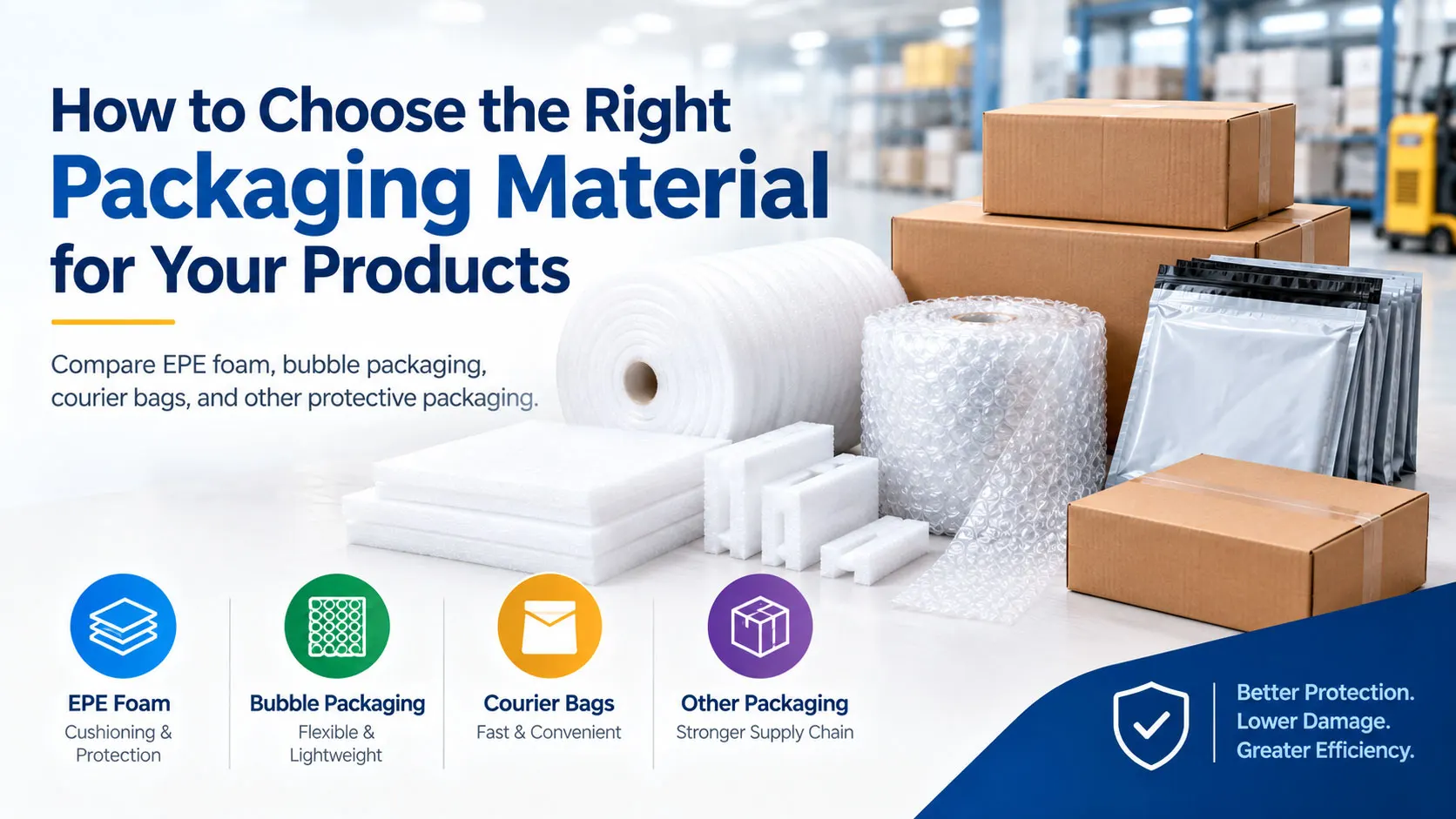
How to Choose the Right Packaging Material for Your Products
A practical guide for UAE manufacturers comparing EPE foam, bubble packaging, courier bags, corrugated boxes and other protective packaging solutions.
Choosing the right packaging material is an important decision for manufacturers in the UAE. The right packaging does more than protect a product during transportation. It can help reduce product damage, improve handling efficiency, control packaging costs and maintain product quality throughout the supply chain.
Products may pass through manufacturing facilities, warehouses, trucks, distribution centres and delivery networks before reaching their destination. During this journey, they can be exposed to impact, vibration, pressure, friction and repeated handling.
In this guide, we compare some of the most commonly used protective packaging materials, with a particular focus on EPE foam packaging. You will learn how each material works, where it is most useful and how UAE manufacturers can select the right solution for their products.
Why Choosing the Right Packaging Material Matters
Packaging plays a critical role throughout the manufacturing and distribution process. Even a strong product can become damaged if it is not properly protected during transportation and storage.
Poor packaging can result in scratches, dents, breakage, surface damage and unnecessary product movement. For manufacturers, these issues can lead to returns, replacement costs, customer complaints and additional logistics expenses.
Therefore, packaging should be selected according to the product’s characteristics and transportation requirements, rather than based only on the lowest material price.
EPE Foam: A Versatile Packaging Solution for Manufacturers
EPE (Expanded Polyethylene) foam is a versatile protective packaging material used across many manufacturing industries. It is lightweight, flexible and provides cushioning between products and external impacts.
EPE foam is available in different forms, including sheets, rolls, profiles and customised shapes. This flexibility makes it suitable for both standard and specialised packaging applications.
Key Benefits of EPE Foam Packaging
Impact Protection
EPE foam helps absorb shocks and provides a cushioning layer that can reduce the risk of damage during handling and transportation.
Surface Protection
Wrapping products with EPE foam can help prevent scratches, scuffs and friction between products and external packaging.
Lightweight
EPE foam provides protective cushioning without adding significant weight to many shipments.
Flexible Applications
Sheets, rolls, profiles and custom-cut pieces can be used for products with different shapes and protection requirements.
Where Can Manufacturers Use EPE Foam?
EPE foam can be used across a wide range of manufacturing sectors. Typical applications include:
- Furniture and furniture components
- Glass and fragile surfaces
- Electrical and electronic products
- Automotive components
- Metal and plastic parts
- Machinery components
- Sanitary and bathroom products
- Appliances and industrial equipment
Bubble Packaging: When Is It a Better Choice?
Bubble packaging uses air-filled bubbles to create a cushioning layer around products. It is commonly used for lightweight and fragile items that require flexible protective wrapping.
Advantages of Bubble Packaging
- Flexible and easy to wrap
- Suitable for lightweight fragile products
- Useful for irregularly shaped products
- Helps reduce surface scratches
- Easy to cut and use for different product sizes
However, the ideal material depends on the product and packaging environment. For manufacturers requiring consistent cushioning, surface protection or customised packaging components, EPE foam may be a more suitable option.
Courier Bags: Best for Lightweight Shipments
Courier bags are primarily designed for shipping and distribution. They are commonly used for documents, clothing, accessories, soft goods and other lightweight products.
Their lightweight construction makes them convenient for shipping operations. However, courier bags generally do not provide the same level of cushioning as dedicated protective materials such as EPE foam.
If a manufactured product is fragile or susceptible to impact, abrasion or surface damage, additional protective packaging may be necessary.
Corrugated Boxes: Structural Protection
Corrugated boxes are widely used across manufacturing and logistics because they provide structural protection and can be produced in different sizes and strengths.
They are useful for shipping finished products, warehouse storage, bulk transportation and combining products with internal protective materials.
For fragile products, however, a corrugated box alone may not provide sufficient cushioning. Manufacturers can combine the box with EPE foam, bubble packaging or other protective materials.
EPE Foam vs Bubble Packaging vs Courier Bags
Each packaging material serves a different purpose. The following comparison can help manufacturers identify the most appropriate solution.
| Packaging Material | Best For | Main Advantage | Protection |
|---|---|---|---|
| EPE Foam | Industrial and fragile products | Cushioning and surface protection | High |
| Bubble Packaging | Lightweight fragile products | Flexible cushioning | Medium–High |
| Courier Bags | Lightweight non-fragile shipments | Lightweight and convenient | Low–Medium |
| Corrugated Boxes | Shipping and bulk packaging | Structural protection | Medium–High |
In many cases, the best packaging solution combines multiple materials. For example, a manufacturer may wrap a product with EPE foam and then place it inside a corrugated box for additional structural protection.
How UAE Manufacturers Can Choose the Right Packaging Material
Instead of selecting packaging based only on appearance or price, manufacturers should evaluate the complete product and logistics process.
Understand Your Product
Evaluate the product’s weight, dimensions, shape, fragility, surface finish, value and sensitivity to impact or abrasion.
Identify the Main Packaging Risk
Consider whether products could be dropped, stacked, compressed or exposed to friction during transportation and handling.
Consider Transportation Conditions
Review how products move between your factory, warehouse, transport provider and customer. Packaging should reflect the expected handling conditions.
Balance Protection and Cost
Consider total packaging costs, including material usage, packing labour, storage, shipping weight and potential product damage.
Consider Custom Packaging
Custom-cut or shaped EPE foam can be useful when standard packaging leaves excessive empty space or fails to protect specific product areas.
Practical Tips to Improve Your Packaging Process
UAE manufacturers can improve packaging efficiency by reviewing their existing process and measuring actual packaging performance.
- Test packaging before large-scale production. Use sample-packed products to evaluate protection under realistic handling conditions.
- Measure damage rates. Track damaged shipments before and after changing packaging materials.
- Reduce unnecessary empty space. Excessive space can allow products to move inside boxes during transportation.
- Standardise packaging sizes. Consistent packaging formats can simplify storage and packing operations.
- Combine protective materials. EPE foam and corrugated boxes can work together to provide cushioning and structural protection.
- Review packaging regularly. Changes in products, shipping routes or customer requirements may require packaging adjustments.
Frequently Asked Questions
Is EPE foam good for product packaging?
Yes. EPE foam is widely used for protective packaging because it is lightweight, flexible and provides cushioning and surface protection. It is suitable for many manufactured products.
What is the difference between EPE foam and bubble packaging?
Both materials provide cushioning, but they have different structures and applications. EPE foam is available in sheets, rolls, profiles and customised forms, while bubble packaging uses air-filled bubbles for cushioning.
Can EPE foam be used with corrugated boxes?
Yes. EPE foam can be placed around or between products inside corrugated boxes to provide additional cushioning and help reduce product movement.
Is EPE foam suitable for industrial packaging?
Yes. EPE foam can be used for various industrial applications, including machinery components, automotive parts, electronics, furniture, sanitary products and other manufactured goods.
How can manufacturers reduce packaging damage?
Start by identifying the main causes of product damage. Then select packaging that addresses those risks. Appropriate cushioning, reduced product movement, packaging tests and material combinations can all improve protection.
Conclusion
Choosing the right packaging material is essential for UAE manufacturers that want to protect products, control packaging costs and maintain an efficient supply chain.
EPE foam is an excellent option for manufacturers looking for lightweight cushioning, surface protection, flexibility and custom packaging possibilities. Bubble packaging can be useful for lightweight fragile products, courier bags are suitable for many non-fragile shipments, while corrugated boxes provide valuable structural protection.
Ultimately, there is no single packaging material that is ideal for every product. The right choice depends on the product’s characteristics, transportation conditions, handling risks and overall packaging requirements.
By evaluating these factors and testing packaging before full-scale implementation, UAE manufacturers can create a more reliable packaging process and reduce avoidable product damage.
Looking for the Right EPE Foam Packaging Solution?
Explore protective packaging options designed to help manufacturers protect products during handling, storage and transportation.
Leave A Comment