
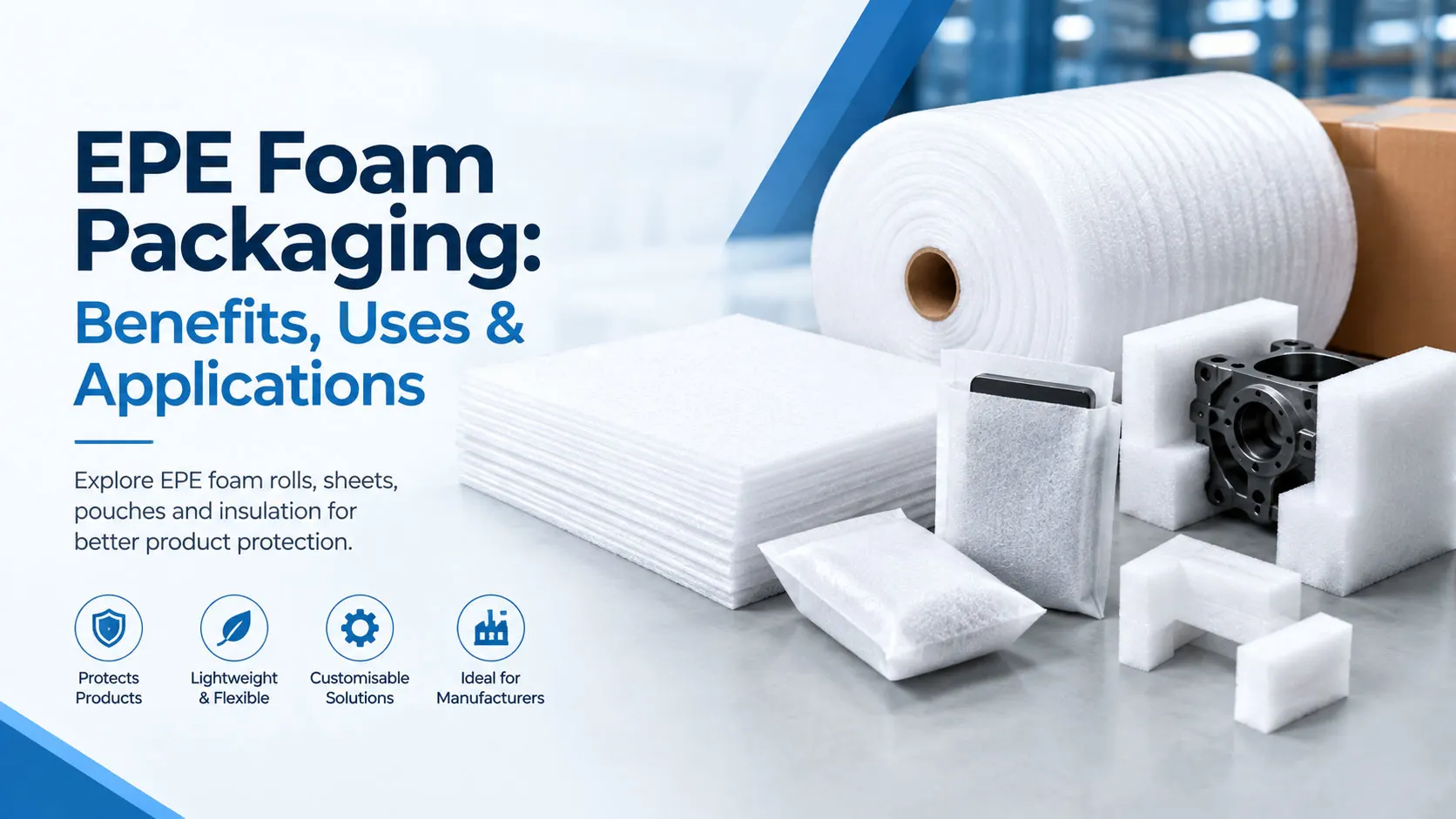
EPE Foam Packaging: Benefits, Uses & Applications
Discover how EPE foam rolls, sheets, pouches and custom protective solutions help UAE manufacturers protect products during handling, storage and transportation.
Product protection is a critical part of modern manufacturing. Products may be handled multiple times before they reach a customer, and inadequate packaging can result in scratches, dents, breakage and other forms of damage.
For manufacturers in the UAE, selecting the right protective packaging can help improve supply chain efficiency while reducing avoidable product damage. One of the most versatile options available is EPE foam packaging.
EPE foam can be supplied in rolls, sheets, pouches, profiles and customised shapes. This makes it suitable for a wide range of industrial, commercial and manufacturing applications.
What Is EPE Foam?
EPE stands for Expanded Polyethylene. It is a lightweight, flexible foam material commonly used for cushioning, insulation and protective packaging.
The closed-cell structure of EPE foam helps provide a cushioning layer between products and external surfaces. As a result, it can help reduce the effects of minor impacts, friction and surface contact during handling and transportation.
EPE foam is also easy to handle and can be converted into different packaging formats depending on the product requirements.
Why Is EPE Foam Popular for Product Protection?
EPE foam combines lightweight construction, flexibility and cushioning properties in a practical packaging material.
Manufacturers can use it as a standalone protective layer or combine it with cartons, boxes, pallets and other packaging materials.
Benefits of EPE Foam Packaging
EPE foam offers several advantages for manufacturers looking for practical protective packaging.
Impact Protection
EPE foam provides cushioning that can help reduce the impact of handling and transportation on packaged products.
Surface Protection
A layer of EPE foam can help prevent scratches, scuffs and friction between products and packaging.
Lightweight Material
EPE foam provides protection while adding relatively little weight to many packaged products.
Flexible & Easy to Handle
Foam can be cut, wrapped, folded or shaped according to different product dimensions and requirements.
Customisable
Manufacturers can use custom-cut foam profiles, inserts and shapes for specialised products.
Suitable for Many Industries
EPE foam can be used for industrial components, electronics, furniture, sanitary products and many other manufactured goods.
Types of EPE Foam Packaging
EPE foam is available in several formats. The best format depends on the product dimensions, protection requirements and packaging process.
EPE Foam Rolls
EPE foam rolls are flexible and convenient for wrapping products of different sizes. They can be cut according to the required length and are useful for high-volume packing operations.
EPE Foam Sheets
EPE foam sheets are useful for separating products, covering surfaces and creating protective layers inside cartons and packaging containers.
EPE Foam Pouches
EPE foam pouches are designed for convenient protection of individual products or components. They can help reduce scratches and surface contact.
EPE Foam Profiles & Inserts
Custom profiles and inserts can be designed to protect edges, corners and specific sections of manufactured products.
EPE Foam for Insulation Applications
In addition to product protection, EPE foam can be used in selected insulation applications because of its lightweight closed-cell structure.
Depending on the product specification and application, EPE foam can provide a layer between surfaces that helps reduce heat transfer and provides additional protection.
Manufacturers should select the appropriate foam density, thickness and construction according to the specific application rather than using a single specification for every requirement.
EPE Foam Uses & Applications
EPE foam is used across a wide range of manufacturing and packaging applications. Its flexibility makes it suitable for both simple wrapping and more specialised protection.
Furniture
Electronics
Automotive Parts
Glass Products
Sanitary Products
Electrical Products
Machinery Components
Metal Products
Plastic Components
Why UAE Manufacturers Use EPE Foam Packaging
UAE manufacturers operate in a supply chain that may involve local distribution as well as regional and international transportation. Products can experience repeated handling between factories, warehouses, transport providers and customers.
EPE foam can provide a practical protective layer during these stages. It can be used around individual products, between components or inside outer cartons.
Common Manufacturing Requirements
- Protecting finished surfaces from scratches
- Separating products during storage and transportation
- Reducing movement inside cartons
- Protecting corners and edges
- Cushioning delicate components
- Creating customised packaging for specific products
EPE Foam vs Other Protective Packaging Materials
EPE foam is not the only protective packaging material available. Manufacturers should compare materials according to the product and application.
| Material | Common Application | Main Benefit | Typical Protection |
|---|---|---|---|
| EPE Foam | Industrial products and surface protection | Lightweight cushioning and flexibility | High |
| Bubble Packaging | Lightweight fragile products | Flexible cushioning | Medium–High |
| Corrugated Boxes | Shipping and storage | Structural protection | Medium–High |
| Courier Bags | Lightweight non-fragile goods | Lightweight shipping solution | Low–Medium |
In many manufacturing applications, combining materials can provide better results. For example, EPE foam can be used inside a corrugated box to provide both cushioning and structural protection.
How to Choose the Right EPE Foam for Your Product
Not every product requires the same EPE foam specification. Before ordering packaging material, manufacturers should evaluate the following factors.
Product Size and Shape
Measure the product carefully and identify areas that need additional protection. Custom-cut foam can be useful for products with unusual shapes or vulnerable edges.
Required Thickness
Foam thickness should be selected according to the level of cushioning and separation required. Heavier or more delicate products may require a different specification from lightweight items.
Packaging Method
Consider whether the foam will be used as a wrapping layer, pouch, insert, separator, edge protector or internal packaging component.
Transportation Conditions
Products shipped over longer distances or handled multiple times may require more robust protective packaging than products transported over short distances.
Cost and Packaging Efficiency
Consider more than the purchase price. Evaluate material usage, packing labour, storage requirements, shipping weight and the potential cost of damaged products.
Practical Tips for Using EPE Foam Packaging
- Measure products accurately before selecting foam dimensions.
- Protect vulnerable areas such as corners, edges and finished surfaces.
- Reduce product movement inside cartons by using suitable foam inserts or separators.
- Test packaging samples before implementing a new packaging system at scale.
- Choose the right thickness and density according to the application and protection required.
- Consider custom solutions when standard foam sheets or rolls do not provide adequate product protection.
Frequently Asked Questions About EPE Foam
What is EPE foam used for?
EPE foam is commonly used for protective packaging, cushioning, surface protection, product separation and selected insulation applications.
What are EPE foam sheets used for?
EPE foam sheets can be used as protective layers, separators, wrapping material and internal packaging components for manufactured products.
What are EPE foam rolls used for?
EPE foam rolls are useful for wrapping products of different sizes. They can be cut to the required length and are suitable for many high-volume packaging operations.
Are EPE foam pouches suitable for fragile products?
EPE foam pouches can help protect individual products and components from scratches, friction and minor impacts. The appropriate specification depends on the product and transportation conditions.
Is EPE foam suitable for industrial packaging?
Yes. EPE foam is used in many industrial packaging applications, including machinery components, automotive parts, electronics, furniture, sanitary products and other manufactured goods.
How do I choose the right EPE foam thickness?
The appropriate thickness depends on the product’s weight, shape, fragility, handling conditions and required level of cushioning. Testing samples before large-scale production is recommended.
Conclusion
EPE foam packaging is a practical and versatile solution for manufacturers looking to protect products during storage, handling and transportation.
From EPE foam rolls and sheets to pouches, profiles and custom protective components, the material can be adapted to a wide range of manufacturing requirements.
For UAE manufacturers, selecting the right EPE foam specification can help improve product protection while supporting an efficient packaging process. The right thickness, format, density and design should always be selected according to the specific product and application.
By testing packaging solutions and identifying the areas where products are most vulnerable, manufacturers can create a more reliable packaging system and reduce avoidable damage throughout the supply chain.
Looking for EPE Foam Packaging Solutions?
Explore EPE foam rolls, sheets, pouches and protective packaging options for manufacturing and industrial applications.
Leave A Comment